UNICEF for every child logo

We welcome feedback and reflections to help refine and improve these resources.

Share Feedback

Resources for using DEPTHS

Learn the foundations

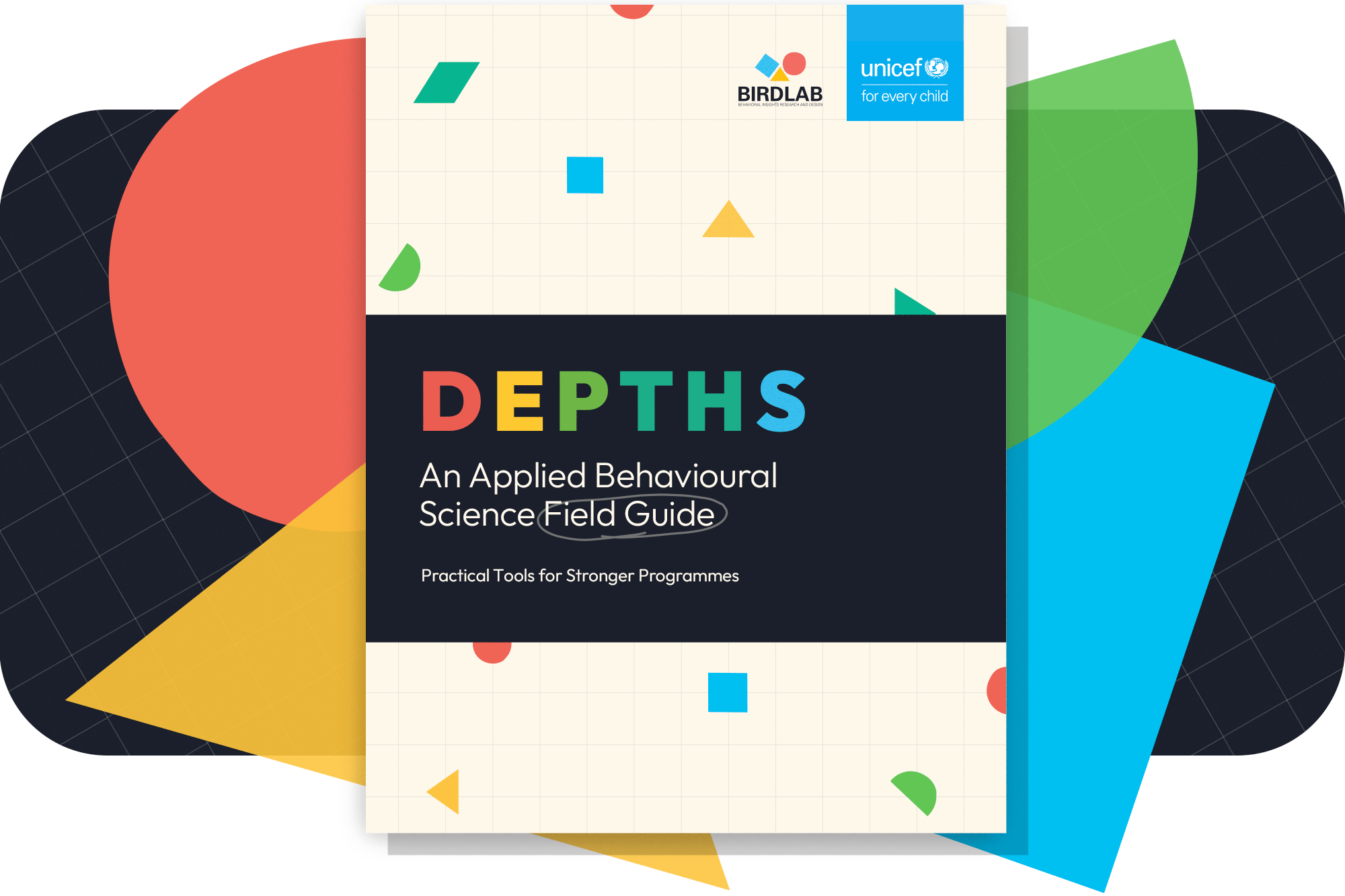
DEPTHS Field Guide

This Field Guide brings together tools, case studies, templates, and techniques to support the application of behavioural science from start to finish.

Apply and Practice

Toolkit

The Toolkit helps turn theory into practice. It offers worksheets and tools for each phase of DEPTHS, illustrated with examples to support understanding. 

TEACH and BUILD CAPACITY

DEPTHS Curriculum

15 modular Lessons and a Facilitators Guide designed to strengthen understanding of applied behavioural science and DEPTHS and to help training and upskilling others.

Before applying DEPTHS, start by understanding what applied behavioural science is and why it matters here: What is Applied Behavioural Science?

Overview of the DEPTHS process

DEPTHS is a systematic process to help practitioners apply behavioural science to real-world problems, developed by UNICEF.

DEPTHS stands for Define, Explore and Diagnose, Prototype Designs, Test Hypotheses, and Scale. It builds on established approaches in Social and Behaviour Change, Human-Centered Design, Systems Thinking and related fields, while adding new tools and evidence to the shared toolbox for ethical behavioural impact.

Find out more about each phase of DEPTHS below!
D

Define

The applied behavioural science journey begins here. Before jumping into conducting research or designing solutions, it is essential to step back and define what success looks like.

1

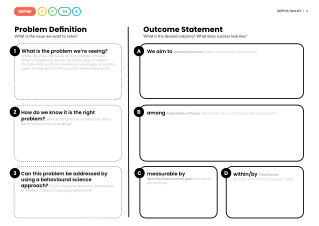
Define the problem and outcomes

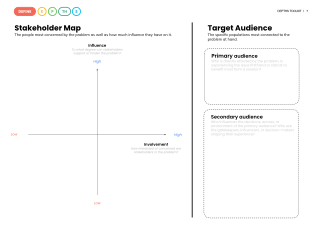
In this step, clearly specify the problem, outcome(s) of interest, and who needs to be engaged.

2

Identify potential target behaviours

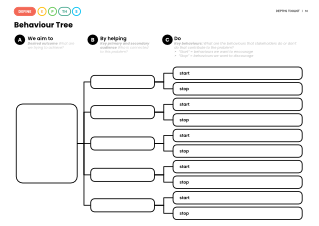
With the problem and outcomes defined, identify the constituent behaviours. Select the behaviours that have the highest potential impact and feasibility of being changed.

3

Map the system (optional)

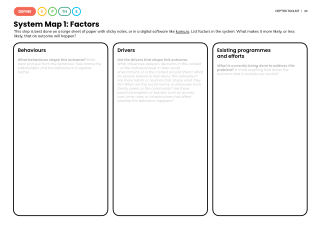
Create a graphic representation of the relationships between different factors in the system. Include both drivers and barriers to success in addressing the problem and achieving the desired outcome.

TOOLS USED
4

Find leverage (optional)

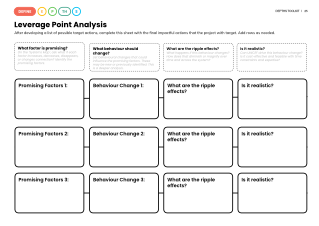
Use the system map to identify leverage points — aspects of a system that, if changed, would have a high impact on the desired outcomes.

5

Document the project and scope

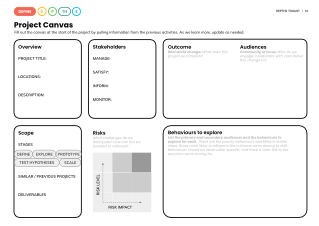
All of the outputs of the Define phase culminate in a one-page summary: the project canvas. This document outlines the intended outcome, leverage points, potential actors and actions that will drive change, as well as team roles and responsibilities.

Expand Phase
E

Explore and Diagnose

Synthesise existing social and behavioural evidence, identify gaps where further research is needed, and use mixed-methods research to uncover the behavioural drivers and barriers influencing the target behaviour.

1

Conduct initial desk research

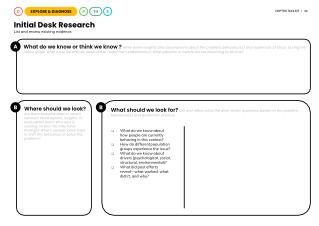
Review existing data and literature to build a foundational understanding of the context. This helps to surface known insights, identify gaps, and determine whether additional research is needed.

2

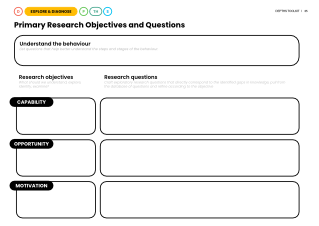
Develop primary research questions

Define clear and behaviourally informed research questions aligned with gaps identified during the desk research. Questions should focus on uncovering why people do or do not perform behaviours, using behavioural frameworks like COM-B.

3

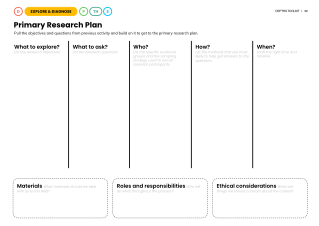
Plan the primary research

Outline the research approach, including who to engage, what methods to use, and how ethical safeguards will be applied. This step ensures that research is practical, targeted, and ethically grounded.

4

Conduct the primary research

Organize and implement fieldwork, including participant recruitment, team training, tool testing, and logistics. Carry out data collection while emphasizing quality, inclusion, and respectful engagement.

5

Analyse and synthesise findings

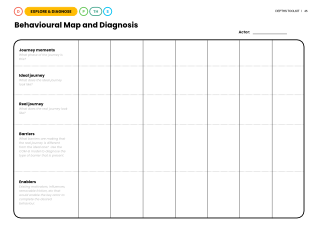
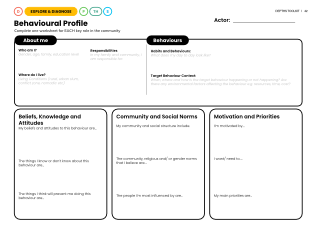
Use the COM-B framework to organize insights, develop behavioural profiles, map micro-behaviours, and prioritize key barriers and enablers that will shape the next stage of design.

Expand Phase
P

Prototype Designs

Brainstorm multiple ideas through creative, co-creation activities with key stakeholders. Use behavioural insights to further develop the most promising ideas into prototype interventions, and gather feedback from the community to ensure the prototypes reflect users’ perspectives.

1

Ideate interventions

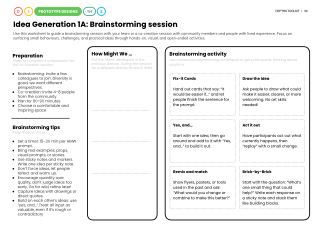
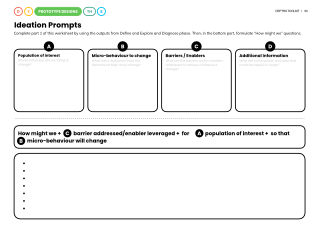
Translate key insights from the Explore & Diagnose phase into actionable prompts. Use these questions and different frameworks to brainstorm a wide range of behaviourally-informed ideas.

2

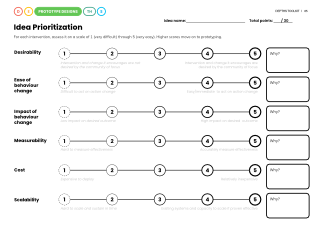
Prioritize interventions

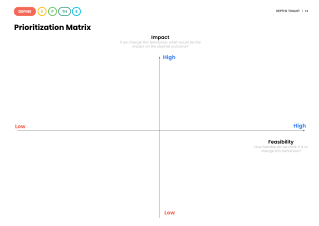
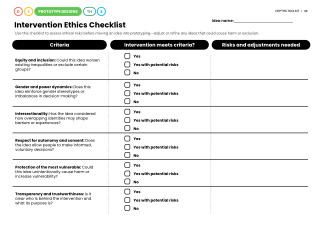
Apply clear criteria such as feasibility, impact, scalability, and ethics to identify the most promising idea(s) to prototype.

3

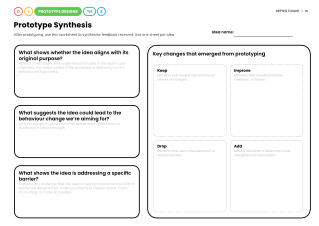
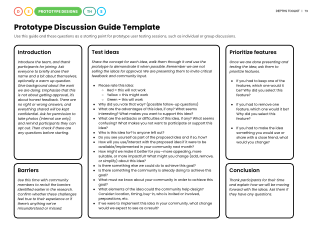
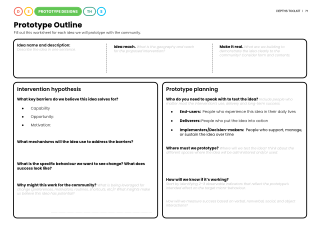
Prototype, test, and iterate interventions

Bring the selected idea(s) to life through prototyping to be tested with users to gather early feedback.

4

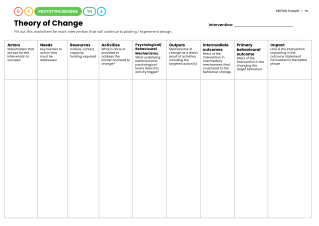
Theory of Change

Refine the intervention based on user testing and map out how and why it is expected to lead to the desired behavioural outcomes, and impact the outcome statement.

Expand Phase
Th

Test Hypotheses

Develop research questions for the selected prototype, design an appropriate evaluation to rigorously test whether the intervention leads to meaningful change in the target behaviour, and capture lessons from the results.

Learn the importance of evaluation

Understand why evaluation matters, the challenge of establishing causation, how counterfactuals help answer what would have happened otherwise, and why randomized controlled trials are the gold standard for understanding impact.

Design rigorous evaluations

Design evaluations that ask the right questions, measure the right outcomes, and generate evidence that directly informs decisions.
Expand Phase
S

Scale

Use lessons from the evaluation to determine the most appropriate scaling approach. Adapt the intervention to new populations, contexts, or systems while preserving what makes it effective. Plan the infrastructure and resources needed for sustained delivery.

1

Decide pathway

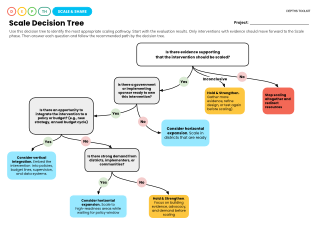
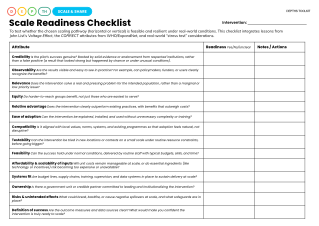
Choose the pathway (horizontal, vertical, or both) and assess the intervention’s readiness for scale.

2

Build support

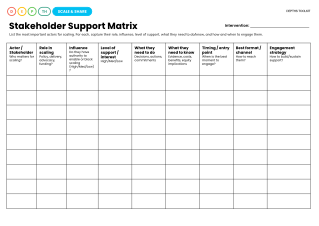
Secure ownership, and align systems, roles and responsibilities amongst actors and stakeholders.

3

Plan for scale

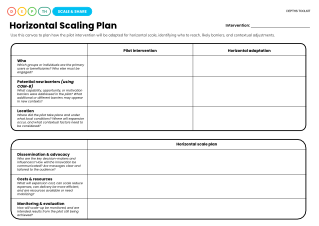
Create a plan according to the scale approach selected in Step 1.

Expand Phase
Much of today’s evidence comes from the Global North, leaving many realities underrepresented. By building and sharing evidence grounded in real-world settings, this journey of applied behavioural science helps shape a more inclusive field and programmes that deliver lasting change — for every child.